
Balloting for action
21 November 2023
Answers to questions commonly asked about balloting for industrial action.
 This page is being regularly updated. The Employment Rights Act 2025 became law on 18 December 2025. The UK government introduced a number of transitional and saving arrangements for the trade union measures of the Employment Rights Act 2025, which came into force on 18 February 2026. Please note that the Employment Rights Act 2025 applies to England, Scotland and Wales. Northern Ireland has a separate 'Good Jobs' Employment Rights Bill; updates on Northern Ireland are pending.
Decision-making and eligibility
Who makes the decisions regarding balloting and the timeframe?
UCU is a member-led union where decisions are made by UCU members themselves. The democratic mechanisms of the union include the annual Congress (UCU's supreme policy-making body), the further and higher education sector conferences (FESC and HESC), and the elected representatives in the national executive committee (NEC) which is also subdivided into the further education committee (FEC) and higher education committee (HEC).
With 'national' ballots (such as a ballot on pay and working conditions in higher education), decisions regarding balloting and the timeframe are usually made by the elected representatives on HEC. With 'local' ballots (such as a ballot on job cuts and redundancies at one employer), decisions regarding balloting and the timeframe are usually made by the affected UCU branch and the relevant UCU national/regional office, and are then authorised by the elected officers in HE or FE.
Who is eligible to vote?
The industrial action ballot electorate by default includes:
- full members (standard membership or standard free membership)
- joint union members.
The industrial action ballot by default excludes:
- student members
- attached/unemployed members
- fully retired members
- members whose membership lapsed (please note that standard free membership expires after a period of time—members are warned well in advance if this is happening—and those standard free members can upgrade their membership via MyUCU)
- members whose workplace is outside of the United Kingdom
- members who have cancelled their membership or resigned from the union
- members with a 'ballot exclusion' in place (e.g. parental leave, long-term absence).
Remember that you can check your membership category by logging into MyUCU. If you are not yet a UCU member, and wish to participate in future industrial action ballots, you can join UCU online right away.
I am about to start parental leave or about to retire, am I eligible to vote?
This is the general rule: a member needs to be absent during the whole 12-month action period following ballot closure to be deemed ineligible to vote and therefore can be excluded from the industrial action ballot.
Being absent for part of the ballot period or action period is irrelevant, if a member is only absent for part of either period then they are still eligible to vote and should therefore vote as normal.
What if I am employed at multiple institutions (and therefore am at multiple UCU branches)?
This depends on whether the ballot is 'aggregated' or 'disaggregated'. In an 'aggregated' industrial action ballot, members employed in more than one institution will only be able to vote once, at their primary institution of employment. You can check your primary institution of employment via MyUCU. In a 'disaggregated' industrial action ballot, members employed in, for the sake of illustration, three balloting institutions will receive three separate and distinct ballot papers--each corresponding to the one balloting institution.
Your ballot paper
What does the ballot pack/envelope look like?
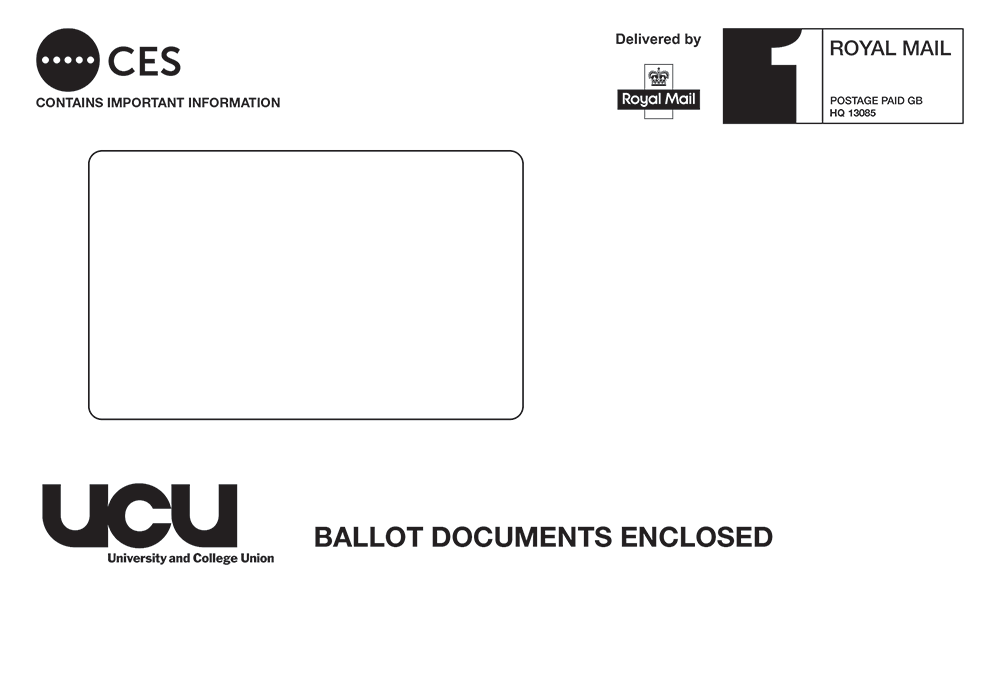
The ballot pack/envelope should have the return address for Civica (Civica Election Services, CES) in the top left-hand corner. It may also carry the CES logo and UCU branding. Click here for a sample envelope.
The ballot pack will contain the ballot paper(s). The ballot pack will often contain a first-class pre-paid return envelope. Members should use the ballot paper and put the ballot paper in the pre-paid return envelope, and then post that at the nearest post box or post office.
What should I do if I have lost the pre-paid return envelope or if it is missing from the ballot pack?
If you have misplaced the pre-paid envelope or the pre-paid envelope is missing from the ballot pack, you can put the ballot paper(s) into a blank envelope, write this address on the envelope—Civica Election Services, 33 Clarendon Road, London N8 0NW—then affix a stamp, ideally first-class, and post it back. It is also possible to hand the ballot back in person at the above address.
What question will appear on the ballot paper(s)?
A ballot paper will usually have one or two questions, for example:
- are you prepared to take industrial action consisting of strike action?
- are you prepared to take industrial action consisting of action short of strike action (which for this purpose is defined to include overtime and call-out bans)?
UCU urges everyone to vote YES to all questions asked.
How should I mark my preference?
The ballot usually includes two simple 'Yes/No' questions, mentioned above. You should write a CROSS (X) to indicate your preference on the ballot paper--for the avoidance of doubt, a CROSS (X) in a box looks like this. Using anything that is not a CROSS (X)--for example a tick (V)--means that Civica Election Services' scanning team will look at your ballot paper and make a judgment as to whether your vote is acceptable.
Would UCU know if I have voted or which way I have voted?
Industrial action ballots are confidential and UCU does not know if an individual member has voted or which way that a member has voted.
As part of a UCU branch's 'get the vote out' (GTVO) activities, your branch may ask you—via email, text message or door-knocking at your workplace—whether you have voted, so that the branch can target their GTVO with precision.
It is always an enormous help to your branch and your union if you volunteer this information (on whether you have voted, not how you have voted). This means there will be no need for UCU to remind you again (for instance via text or phone-banking).
I have not received my ballot pack. What should I do?
If you do not receive your ballot pack, you will be able to request another using UCU's replacement ballot request form--details of which will be supplied for each separate ballot. To use the replacement ballot request form, you need to use your unique UCU membership number.
I do not know or have forgotten my UCU membership number. How do I find out what it is?
If you do not know your UCU membership number, you can send a blank email to mynumber@mercury.ucu.org.uk using the email address we hold for you (usually where you receive the Friday campaigns email and other union communications), and your number will be emailed back. You could also try logging into MyUCU to grab your membership number. If everything fails, you can email UCU's membership department.
Why can't I vote electronically/online?
The law currently mandates that a ballot for industrial action must be conducted by post. It is therefore not possible to participate in the industrial action ballot electronically/online.
The law also states that a ballot for industrial action must be supervised by a qualified independent scrutineer, usually Civica Election Services (CES). CES is responsible for the production, posting, and processing of ballot papers. UCU cannot by law produce, post, or process ballot papers. It is not possible for UCU or CES to send out a ballot paper electronically for you to print out at home or at work.
 Under the Employment Rights Act 2025 (England, Scotland and Wales), trade union members may be able to vote electronically for industrial action if the employer and trade union agree. However this change is projected to take place after August 2026. In the meantime, the postal ballot requirement applies.
Is there a turnout requirement in industrial action requirements?
The law currently mandates that--in England, Scotland and Wales--a ballot for industrial action is successful if there is a majority 'YES' vote and a turnout of 50% or above. To illustrate:
- if a ballot has 90% 'YES' vote for strike action, and a turnout of 45%, then union members do not have a legal mandate for industrial action
- if a ballot has 45% 'YES' vote for strike action, and a turnout of 90%, then union members do not have a legal mandate for industrial action
- if a ballot has 45% 'YES' vote for strike action, and a turnout of 45%, then union members do not have a legal mandate for industrial action
- if a ballot has 90% 'YES' vote for strike action, and a turnout of 55%, then union members do have a legal mandate for industrial action.
Note that the turnout requirement does not apply in Northern Ireland. For a ballot for industrial action to be successful in Northern Ireland, there needs to be a majority 'YES' vote.
Under the Employment Rights Act 2025 (England, Scotland and Wales), the 50% turnout requirement will be removed. However this change is projected to take place after August 2026. In the meantime, the 50% turnout requirement continues to apply in England, Scotland and Wales.
What happens after the ballot, or what action will UCU members be called upon to take?
In the case of a 'national' ballot, once the ballot closes and the results are announced, the democratic bodies of the union--either the higher education or further education committee--will meet and determine the next steps.
In the case of a 'local' ballot, once the ballot closes and the results are announced, the affected UCU branch and the relevant UCU national/regional office will determine the next steps; these are then authorised by the elected officers in HE or FE
In other words, it is up to UCU members and their elected representatives to decide what action they wish to take after the ballot.
In legal terms, in the United Kingdom--except Northern Ireland--a successful industrial action ballot (i.e. a majority 'Yes' vote and a turnout of 50% or above) provides a legal mandate for industrial action for a period of 12 months, starting from the date when the ballot closes.
Under the transitional arrangements of the Employment Rights Act 2025 (England, Scotland and Wales), a successful ballot that opened on or after 18 February 2026 will have a 12-month mandate for industrial action. The 12-month mandate starts from the date when the ballot closes. For a successful ballot that opened before 18 February 2026, the old law would apply and the mandate for industrial action is 6 months, starting from the date when the ballot closes. Note that it is the opening date, not the closing date, that is important here. Click here for illustrative examples on the UK government website.
What do I do if I have a question about the ballot that is not covered here?
This FAQ is continually reviewed and there are also other FAQs to consult. If you have a pressing question about the ballot that is not covered here, please contact the UCU campaigns team and we will either reply to you directly or provide a response on this page.
Please also note that it is generally not possible for a FAQ document to cover the often unique circumstances of every member. For casework support or for advice tailored to your precise circumstances, please contact your branch or the relevant national/regional office. For questions pertaining to your membership record and personal data, please contact the membership department.
- PrintPrint this page
- Share